
The Tiyeni, Early steps towards a holistic approach to rural livelihoods in Malawi
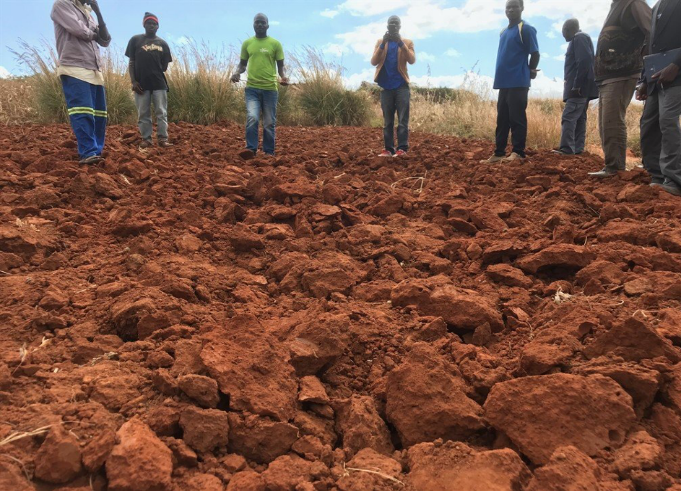
Hardpans – A focus upon their creation by human activity
Context
To increase yields of rain fed crops like maize etc it is essential that there is enough soil moisture and it is increasingly important to harvest rainwater and store it as much as possible in the soil. In many areas in the world the percolation of rainwater and the penetration of roots is obstructed by the existence of Hardpan, which is a hard layer of compacted soil beneath the surface. By understanding this, farmers become effective soil and water managers.
This short document will describe several types of this Hardpan and some of the effects.
1.0 Introduction
1.1 What is well documented now is that, although the soil is made up of mineral “aggregates” ranging from coarse sand through silts and loams to fine particled heavy clay, it is the many multifarious living organisms that make up the soil – from inert “dirt” into the healthy and fertile medium needed to grow crops.
1.2 It is this fertility created by the web of life existing within the mineral components of the soil which can be so badly affected by Hardpan – a layer that blocks water and roots from going deeper into the soil
2.0 Soil Compaction
2.1 Compaction takes place when the soil structure created by the living organisms is collapsed.
2.2 This can be caused commonly by heavy loading (a vehicle or constant foot traffic for example) or extreme events such as a landslide or an intense fire.
2.3 The area of compaction becomes unable to support the rich range of life forms so necessary to a productive soil, due to the collapsing of the structure of that soil.
2.4 Imagine a large block of flats, with all those rooms/spaces where so many people carry out the complex actions of their lives. Then imagine that building demolished into a pile of rubble where all the spaces have been collapsed, and where nobody could live. That is the difference between healthy and compacted soil.
3.0 Hardpans – natural and induced.
3.1 Naturals – Hardpan can be an extreme form of compaction. It is extreme because it takes place over a wide area. Hardpan can exist naturally without compaction – there are examples of naturally occurring hardpans in laterite soils caused chemically – and shallow bedrock hardpans which are often impervious. Two very relevant papers on this can be found at:
https://www.tandfonline.com/doi/epdf/10.1080/00167617408728835
and
https://www.sciencedirect.com/science/article/abs/pii/S0140196318311984
These naturally formed hardpans are not the subject of this paper.
3.2 Human induced
3.2.1 Plough Pan
3.2.2 In the 1930s in mid America there was a well-documented agricultural disaster known as “the dust bowl”. The result was a catastrophic loss of topsoil through (mainly) wind erosion resulting in prolonged and severe dust storms.
3.2.3 A key cause of these dust storms was the loss of soil structure in the topsoil by excessive tillage. But it is very likely that there was an underlying (literally) cause of loss of fertility as well.
3.2.4 At the depth of the “shoe” of a plough or the bottom section of a disc plough, something insidious may have been happening. Soil above the plough was being loosened and turned over, but below that plough an equal and opposite reaction resulted in compression of that lower soil to create a compacted layer.
3.2.5 It was the continual tilling of the land year after year which will have resulted in an ever-increasing Plough Hardpan – also increasing in depth over the years.
3.2.6 Similar problems were being encountered in Brazil. A report on soil conditions
https://www.sciencedirect.com/science/article/pii/S2095633915300599
identified widespread problems of hardpans caused by disc ploughs and “Subsurface compaction (‘panning’) due to repeated annual disc-‐tillage on ……. soil in the Brazilian cerrado region.
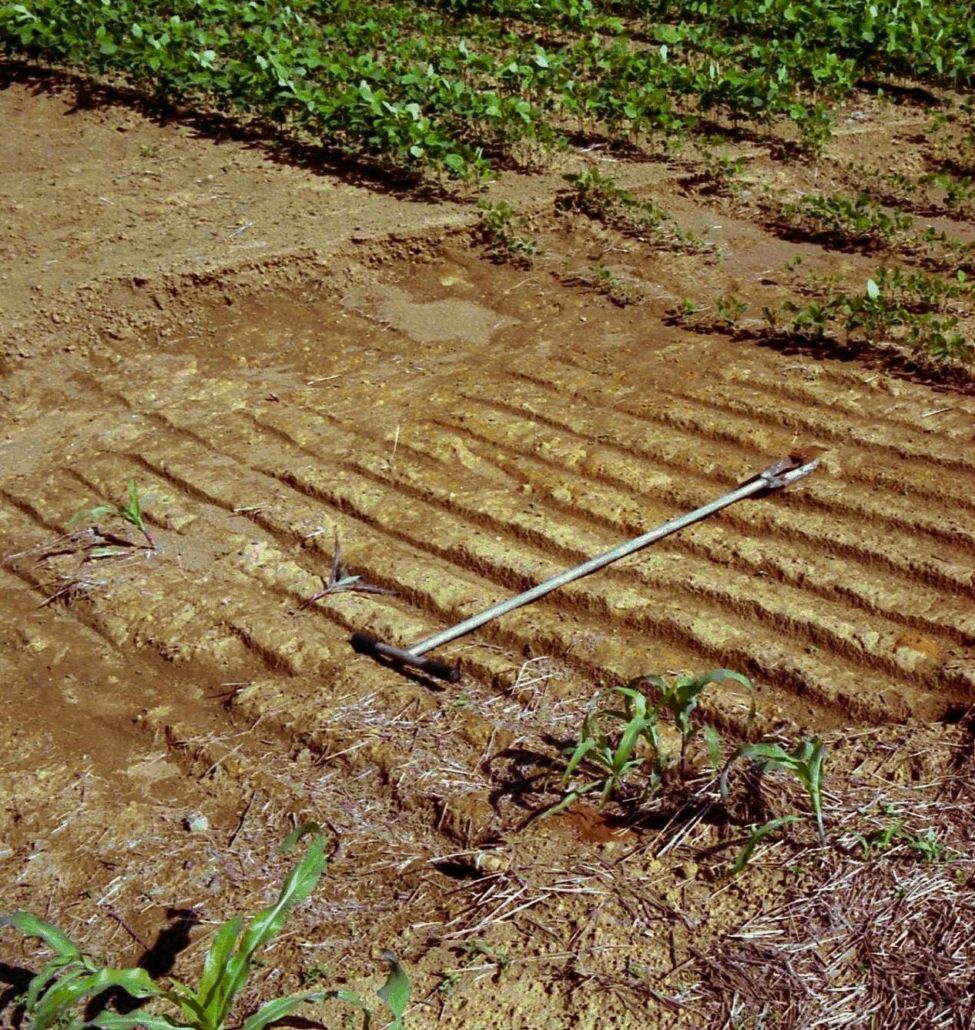
Picture 1 – Disc plough marks in underlying hardpan (soil auger for scale)
Photo T F Shaxson: Brazilian Cerrado 1980
3.2.7 Roll forward to 2014 and the State of Pennsylvania published a report looking at the then current plough pan in its soils. The dust bowl mistakes had been corrected – or so it appeared, because the soil had not been blown away. So! what is this State report about?
3.2.8 Compaction! Using a penetrometer, it was found that the deeper into the soil, the greater the compaction down to 25cm or 10 inches. Below this, compaction began to reduce. This is where the “knee diagram” appeared, showing maximum compaction at around 25cm or 10 inches below the surface – about the same depth as a disc plough.

3.2.9 See report in opening pages
https://extension.psu.edu/effects-of-soil-compaction
If top soils are tilled, but to insufficient depth, (i.e.still above the “knee” in these diagrams – the point of highest soil density) the hardest layer is left intact and the Hardpan remains.
3.3 Surface Pan
3.3.1 If bare soil is exposed to the elements, it will nearly always be in danger of deterioration. In nature, bare soils are uncommon and for it to be bare, some specific event will have occurred to make it so – be it a fire, a landslide, a flood or a severe drought.
3.3.2 A raindrop falling at its terminal velocity will hit any bare soil with great force. And after many drops, the top few millimetres of soil will compact. Follow that rain with sun or wind and the bare wet soil will dry out on the surface and become a hard surface layer – Surface Pan. This can be broken up manually very simply, but if it is not, then the next rain that falls will hit that surface hardpan and tend to runoff. It will not percolate easily. So, water is lost and erosion is likely.
3.4 Foot Traffic Pan
3.4.1 Look at any well-used footpath across land and you will see bare earth exposed where nothing is growing. The reason nothing is growing is not because feet have crushed the plants but that compaction has taken place, collapsing the soil in to a solid mass that cannot support life. In the case of a footpath there is a linear compaction. So how does Foot Traffic Pan get made? (“Pan” meaning existing over a large area rather than just in a linear path).
3.4.2 In Malawi, until the 1920s, most farming was based on “shifting cultivation”, a method then widely used in S E Africa. It involved scattering seed and seedlings over an area of land having burned the foliage off it first, and farming the land for 2 or 3 years before it lost its fertility, when the farmer would move on to another piece of land. The soil would recover and after a few years the farmer might return to that land to farm it again. See The Nyasaland Survey Papers 1938-1943. Berry and Petty ISBN 0-9509470-2-4.
3.4.3 This worked with a population in Malawi of about 1 million but as the population started to grow, farmers started to remain on the same land permanently and in order to keep fertility, they started to use hoes to form ridges and furrows to grow the crops. Population in 2023 estimated at 20 million.
3.4.4 Every year they would take the ridges used to grow the previous year’s crop and split them in half, pushing half the ridge one way and half the other way into the adjacent ridges. In other words, the new cropping ridges would be positioned directly over the previous year’s furrows.
3.4.5 These furrows had collected water and also been used by the farmers to walk in, while they tended or harvested the crops. So, the furrows acted as informal footpaths. The following year they would do the same ridge splitting, bringing the new ridges over the previous year’s “footpaths”, and so on.

Picture 2 – Foot Traffic Pan. It is possible to see the signs of successive compactions. Photo F Gondwe: Madisi 2019
3.4.6 This was a very effective (and ultimately, disastrous) way of ensuring that the whole fields would become compacted, increasing each time the new ridges were formed on top of the compacted furrows.
3.4.7. Over the years, this foot traffic covered the whole areas of the fields several times and often doing so in wet weather. This resulted in the formation of Foot Traffic Pan.

Picture 3 – Only a thin layer of soil above the hardpan. Photo I Chavula: Rhumpi 2021
3.5 Hoe Pan
3.5.1. Hoe Pan is caused by long term use of the hand hoe. By the late 1930s, most farming in Malawi was “static” meaning that shifting cultivation had pretty much been phased out.
3.5.2 Growing population pressures and the limited farmable land available meant that agriculture was becoming more intense. The ridge and furrow method was widely used, and productive crops were grown for many years.
3.5.3 But there was an insidious problem being created and over the next 70 years, culminating in the FAO report in 1999, soil was losing its fertility. Increasing amounts of fertiliser were needed to maintain food crops. This was noted in the FAO report TCI Paper Series No 10 in November 1999 by Shaxson et al:- “An Investigation into the Presence of Cultivation Hoe Pan under Smallholder Farming Conditions”. Paragraph 28 on page 7 makes it very clear that rootzone improvement and water percolation as a result of breaking the hoe pan is recommended.
3.5.4 FAO reports in 1997 and 2016 (ISBN 978-92-5-109516-4 (FAO) identified that 29 tonnes of topsoil were being lost from every hectare of farmed land in Malawi – every year. Severe periods of hunger were being experienced. Flooding and siltation were become more common.
3.5.5 At one hoe depth down into the soil a hard layer of compaction had been forming since hoes had started to be used extensively in the 1930s. So, added to 70 years of foot traffic pan, was also 70 years of hand hoe use – and the resultant Hoe Pan
3.5.6 The constant use of hoes to till the soils added to the density of the hardpan – those hoes carrying out a similar damaging process that took place back in the dust bowl in the mid-west of America in the 1930s.
3.5.7 When a hoe, with its blunt leading edge, is wielded by a farmer, it penetrates the soil at an angle (typically at about 45 degrees) and all the materials above the hoe blade are loosened and aerated. But for each action there is an equal and opposite reaction and here there is no exception. The soil beneath the hoe blade is compacted. The farmer does this year after year. The compaction becomes increasingly dense.
3.5.8 This widespread development of hardpans in nearly all areas of Malawi has resulted in a degradation which is continuing year on year.
3.5.9 The joint effect of foot traffic pan and hoe pan means that neither water not roots can penetrate the hard layer, so the rootzone is limited and the crops are extremely vulnerable to a dry period during the growing season (which is becoming increasingly common due to climate change). Rain does not percolate into the topsoil and subsoil but mainly runs downhill over the surface.

Picture 4 – Surface runoff Photo G Kumwenda Mulange 2022
3.5.10 Failed crops are bad enough, but then because the water runs off so quickly (because it cannot percolate the subsoil, because of the hardpan), the land suffers from catastrophic erosion, high intensity flooding, siltation and water loss.
3.5.11 Dry periods during the growing season and more intense rainfall is due to weather patterns changing because of climate change. The intensity of resultant flooding can be reduced if the flow of water downhill, above and below the soil surface, is slowed down. One way of doing this is by stopping the water running downhill on the surface and getting it to percolate into the soil. This moisture may well then be available for the future.
See extract from FAO report: – https://www.fao.org/3/y4690e/y4690e09.htm
3.5.12 Of course, if the water is allowed to run downhill over the soil surface, it will take topsoil with it, as noted in section 3.5.4 above and often eroding the topsoil down to the Hardpan.

Picture 5 – Severe erosion of topsoil with hardpan visible. Photo F Shaxson, Zomba 2002
4.0 Water – Hardpan and SDG6.1, the Sustainable Development Goal for water
4.1 Breaking the Harpan helps nature to percolate water into the soil and subsoil. Rain water also can recharge shallow ground water layers. The speed of this recharge depends very much on the geology and can take considerable time.
4.2 Groundwater is increasingly important in being able to reach SDG6.1. Over 70% of all water supply in Sub Saharan Africa comes from groundwater. There are still some 300 million people in rural areas in Sub Saharan Africa who do not have a “basic water service” (an improved water source within 30 minutes return trip from home, including queueing time).
4.3 The people who form this SDG6.1 target group often live in dispersed areas and to serve them with conventional technologies such as imported well drilling rigs and imported hand pumps would cost $150 per person or more. Using innovative and locally produced technologies like manual well drilling and locally produced pumps (so called SMARTechs) reduces the cost to $25 per person.
4.4 With SMARTechs it is possible in many areas to make small farm wells at a cost of $500 – $1000. A farm well will supply on average 40 people with water for domestic use. The family that has the well by its house can also use water for productive uses like livestock and small scale irrigation.
4.5 So, breaking the Hardpan in combination with SMARTechs has great potential to assist in reaching SDG6.1 for people in rural Africa , a group that now is largely left behind.
4.6 Organisations and governments interested in providing a “basic water service” in rural areas can consider, where technically possible, subsidising farm wells and thereby reach SDG6.1 (but also SDGs for poverty, food, gender and climate). This would be supported self-supply.
4.7 Farm families who already have “basic service” could/should be assisted with micro loans or other payment options so they can fund an on site domestic water supply for themselves. This would be full self-supply.
4.8 In order to maintain reliability, water taken from the aquifer must at least equal replenishment. This is achieved by recharging the soil and subsoil from (mainly) farmland. Breaking the obstructive Hardpan in all fields is essential to ensure optimum percolation, leading to absorbtion by the soil and subsoil.
4.9 The fact that this breaking of the Hardpan also has a very substantial beneficial effect on crop yields means that, potentially, smallholders see this as a very attractive option. The twin achievements of better crops and soil based water availability, means farmers would also recognise their role as key water managers.
5.0 Summary
5.1. Hardpan is a potential problem wherever humans interact with soils. Good land husbandry will ensure that hardpans are removed, reduced or better still, never formed in the first place.
5.2 The role of “No Till” is important in achieving this. However, no till on land with severe Hardpans will not be effective until that Hardpan is broken.
5.3 It can be broken biologically with sufficient time, however the quickest and most effective way of dealing with it is to break that hardpan physically. Clearly this is a very heavy task which may initially discourage many farmers. However, the positive livelihood consequences of adopting the technologies of Deep Bed Farming in terms of increased crop yields and more groundwater is a very positive inducement to smallholder farmers.
5.4 Small areas of land can be broken by pickaxe and there are a range of other more mechanical ways of breaking larger areas – and considerable research on this is in progress. Great care must be taken when using machinery not to create an even worse Hardpan at a greater depth.
5.5 Once the Hardpan is broken, it is best to apply “no till” principles for good soil health and water conservation and to avoid recompaction.
5.6 Breaking the Hardpan is a key part of the concept Deep Bed Farming (which includes many other elements such as mulching, cover crops, rotation, composting etc). This results in more than doubling yields of rain fed crops like maize. In Malawi, already over 30,000 famers apply this concept and it is now being promoted by government extension officers.
6.0 The Goal
Create the conditions where all smallholders and farmers, whilst improving crop yields and soil health, are given the responsibility to be prime water managers of their own land. If they all do this effectively, then their contribution to the country’s groundwater issues will help to achieve positive change.
Francis Shaxson OBE and Colin Andrews colin.andrews@tiyeni.org 15.6 2023
The Tiyeni presentation on the use of Deep Bed Farming as a solution to hardpan is available here.


